The Icon
of the Glykophilousa
During the period of iconoclasm, Victoria, the wife of the senator Symeon, committed the venerable icon to the sea to save it from desecration.
NARRATIVE OF THE HOLY AND WONDERWORKING ICON
In the days of the Emperor Theophilos the Iconoclast, a certain patrician named Symeon, a member of the Senate, had a pious and virtuous wife who secretly venerated the holy icons, Victoria by name. This ever-memorable woman kept in her house the wondrous icon of the Glykophilousa of which we speak; and the impious iconoclasts were then making a thorough search everywhere to find holy icons and deliver them to the fire, they themselves being liable to the eternal fire. Then the said honourable woman Victoria, pressed by her husband, who was himself an iconoclast, to hand over this holy icon of the Glykophilousa to those who sought it, was compelled to remove it from her house; and, enlightened by God, she took it in her hands, went down to the shore near her house, kissed it with pain of heart and many tears, and, calling upon the Lady Theotokos to preserve it unharmed in whatever way she knew, she placed it in the sea, hoping that she would enjoy it again after the madness of iconoclasm had passed. The holy icon, standing upright, floated marvellously upon the waters; and so the woman, having venerated it, returned to her house giving thanks to the Mother of God, while the holy icon, having marvellously crossed the Sea of Marmara, the Hellespont and the Aegean, came to harbour at the Holy Mountain, in the port of the holy Monastery of Philotheou, at the very place where the holy spring (hagiasma) is found to this day, and revealed itself to its Abbot, that he should come down and receive it. The Abbot, filled with boundless joy at gaining so precious a treasure, went down with the rest of the Fathers to the shore in procession; and seeing the wondrous icon shining forth with divine light, the Abbot received it into his hands, and when it came out of the sea, O the wonder! water gushed forth at the spot where the holy icon first stood, healing every disease, as is seen to this day; and with psalms and hymns, with lights and incense, they brought it up to the holy Monastery and set it in the place where it stands to this day. From that time until now, every year on Bright Monday, in remembrance of the miracle, a procession and blessing of the waters is held. Such grace does the icon possess that, when one gazes upon it without blinking, fear and trembling truly seize him. As for the miracles wrought through it, it is almost impossible to describe them; we content ourselves with writing a few, as assurance of the many.
In the year 1713 there was in this holy Monastery of Philotheou a devout and virtuous ecclesiarch named Ioannikios, who came every day, as was the custom, and lit the lamps. Coming also before this holy icon, he would stand gazing at it reverently and say to it with reverence: «Why, O Lady, has your grace endowed all the other holy monasteries of the Mountain with revenues and various estates, so that they have wheat, wine, oil and much else in abundance, while this Monastery lacks everything and has not even wheat, but must buy it?» These and similar things Ioannikios said every day. One night, having come again to prepare the lamps, and standing before the holy icon, he prayed fervently with tears; and, growing weary, he sat down in the stall opposite, pondering. Falling asleep, he saw in his sleep the Consolation of the sorrowful, I mean the Lady Theotokos, saying to him: «Why, my child Ioannikios, do you trouble me so often, saying that I provide only for the other monasteries of the Holy Mountain, while this Monastery alone is left in poverty? Know, then, that I have the care of all its needs. But I have so decided, in order that the abbots, superiors and stewards of each period may not give themselves wholly to earthly things and neglect their salvation. Therefore cease henceforth to trouble me about this, for I am the Overseer and Provider of this Monastery in all things; do not concern yourself with this, but tend my church faithfully and take care for the salvation of your soul.» Hearing this, Ioannikios awoke trembling and at the same time overjoyed; running, he fell before the holy icon and with tears asked forgiveness, and going out he told the brethren what he had seen, and all marvelled and rejoiced greatly.
In the year 1801 a stranger came to the Monastery to venerate; entering the church, he venerated also the holy icon of the Glykophilousa, and seeing the gold coins hanging upon it, the wretch wickedly resolved to steal them. So after Matins he hid himself in a stall; the ecclesiarch, having locked the door of the church, went away to his cell. Then that thief made bold, took the coins, and at once leaving the church fled secretly; going down to the harbour of the holy Monastery of Iviron he found a ship ready to depart, boarded it, and, the wind being favourable, it sailed at once. But having sailed about one mile, the ship stopped motionless, O the wonder! in the middle of the sea, and that while a favourable wind was blowing. Seeing this strange thing, the captain was perplexed, not knowing its cause. While the ship thus stood motionless and the sacrilegious man was gripped by horror and dread, the hour came for the ecclesiarch to sound the signal in the monastery for the reading of the Third-Sixth Hour; entering the church and seeing that the gold coins were missing from the icon, he at once suspected the theft that had been committed and reported it to the elders, who sent two brothers to the shore to overtake the sacrilegious man. These, seeing from afar the ship standing motionless, ran to the harbour of the said Monastery of Iviron, boarded a small boat, reached the ship that was standing still and climbed aboard. The sacrilegious man, before they could tell the captain what had happened, came and fell at the feet of the brothers, giving back to them the gold coins and asking forgiveness with tears. The brothers took the coins and forgave him his sin, as one led astray by the devil, and so returned to the Monastery, recounting to the brethren the strange miracle of the ship’s immobility; whereupon they sang hymns of thanksgiving, glorifying and magnifying the all-praised Theotokos, who through her wonderworking icon of the Glykophilousa works such wonders.
In the year 1800 devout pilgrims came to this holy Monastery of Philotheou from a village of Thessaloniki called Berovo. Guided by the most holy Elder Anthimos of Philotheou, they came and reverently venerated the holy relics and the wondrous icon of the Glykophilousa. The ecclesiarch related to them the many supernatural wonders which it had wrought and still works for those who call upon it with faith. In the evening the brethren hospitably lodged them in the guesthouse (archontariki), and so they all went to sleep. One of them rose at midnight, wishing to tend his horse, and seeing the window open, thought, being dazed from sleep and supper, that it was the door of the guesthouse; and so he went out heedlessly and fell down from the third storey outside the Monastery onto a great heap of stones. As he fell he remembered the miracles of the wonderworking Glykophilousa and cried out, «Most Holy Theotokos, help me!» And at once there appeared to him what seemed a nun, who held him; and he remained straightway unharmed by that terrible fall and the striking of the stones. Coming to himself, he went to the gate of the Monastery and knocked for them to open to him. A hierodeacon named Meletios, brother according to the flesh of the former abbot Kallinikos, heard him and informed his elder, the sacristan Sophronios; who, learning that the one knocking was one of the pilgrims and that he had fallen from the window, ordered the gate to be opened to him; and seeing him wholly sound and unharmed, all marvelled. He then related to them what had happened to him as above, and they warmly thanked the Lady of all for her swift help to those who devoutly call upon her. The man who had been delivered from danger came every year to venerate the august icon of the Lady Glykophilousa; he dedicated his horse to the Monastery, and a silver lamp to the holy icon.
The said former abbot Kallinikos, coming with forty pilgrims from Ainos, was hastening to reach the Monastery before the feast of the divine Annunciation, so as to celebrate there both the divine Annunciation and Holy Pascha together, since in that year they coincided, which is called Kyrion Pascha (the Lord’s Pascha). When they were between Lemnos and Imbros, a violent wind arose in the night, and a storm so great that all on board despaired and awaited certain death, lamenting bitterly. The said former abbot Kallinikos was grieved more than the others, yet did not despair, but comforted them all, urging them to take courage in the Lady Theotokos, since she had many times kept him unharmed in great dangers and necessities. The ship was being carried by the violence of the wind and was drawing near to a very rough and exceedingly dangerous place called Karagatzi; and had the wind driven the ship there, all would surely have drowned. But what did the Theotokos arrange? The rudder of the ship fell away strangely and was lost from the helmsman’s hands; and the ship, marvellously steered by the Theotokos, came to harbour in a sandy and safe place, and there settled upon the sand, and the people had no idea where they were. When day broke, and they saw to their amazement that the ship had settled safely upon the sand, with the rudder tied behind it, they marvelled at the providence of the Theotokos. Going ashore, they learned that they were opposite the island of Thasos, between Xanthi and Traianoupolis. Then sailing on from there they reached the Monastery and celebrated a threefold feast: that of Pascha, that of the divine Annunciation, and their deliverance from shipwreck, recounting to the brethren all that had befallen them as above.
Indeed the said former abbot Kallinikos confessed great graces from the Theotokos, Queen of all, not only for this miracle but for many others which he had received from her; for, travelling in many and various places to seek alms for the aid of the Monastery, he was kept unharmed from robbers on the road, preserved unhurt from the plague, and many times delivered from pirates and shipwrecks.
A Christian from the village of Ainos called Paraora had a wife who had been barren and childless for many years. Coming to venerate this wonderworking icon of the Glykophilousa, he took with him a little oil from its lamp; returning to his house, he anointed himself and his wife with it, with reverence and faith, and, O the wonder! in that same year the woman conceived and bore a son. In gratitude for the grace, he offered as a gift to the holy Monastery a mule, openly confessing the wonderworking of the Lady Theotokos Glykophilousa; and the brethren marvelled, since they had known nothing at all of the oil which the said Christian had taken with reverence and faith.
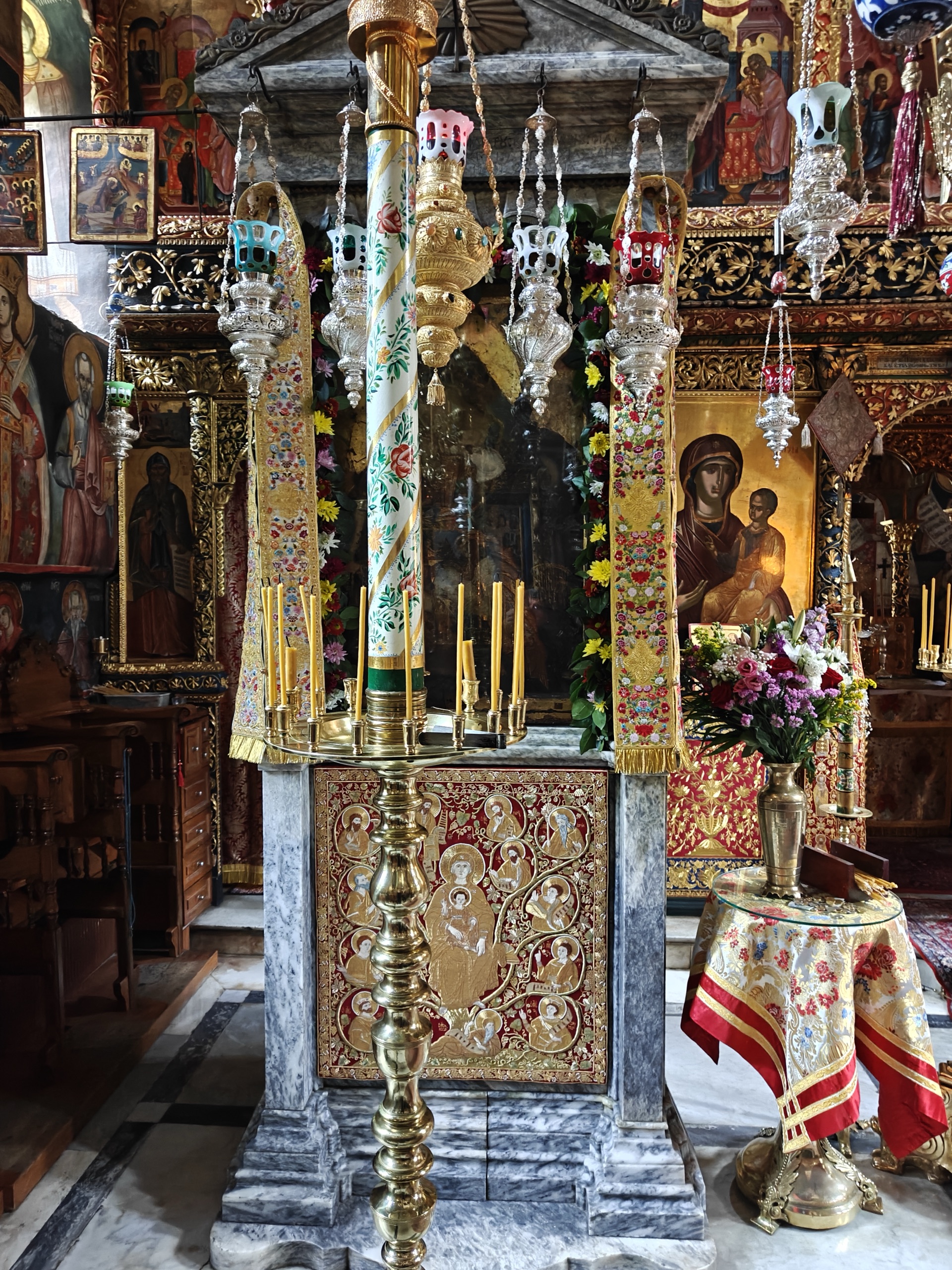
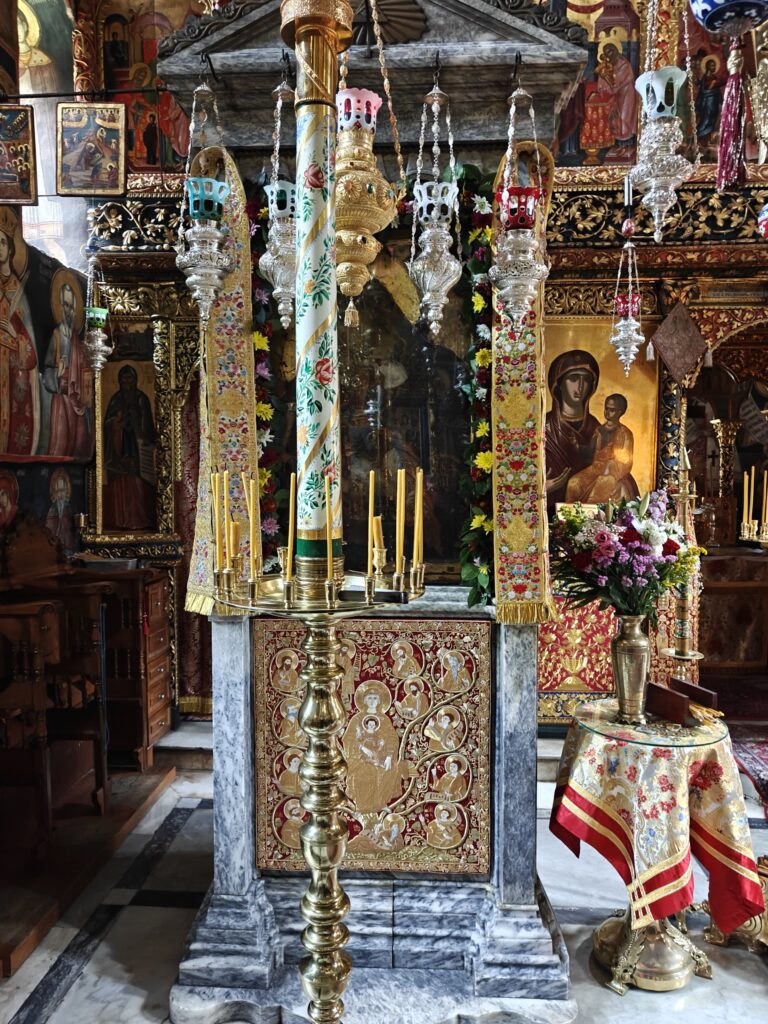
This holy icon stands upon the pillar of the left choir of the Katholikon of the holy church.
Four elements — four mysteries
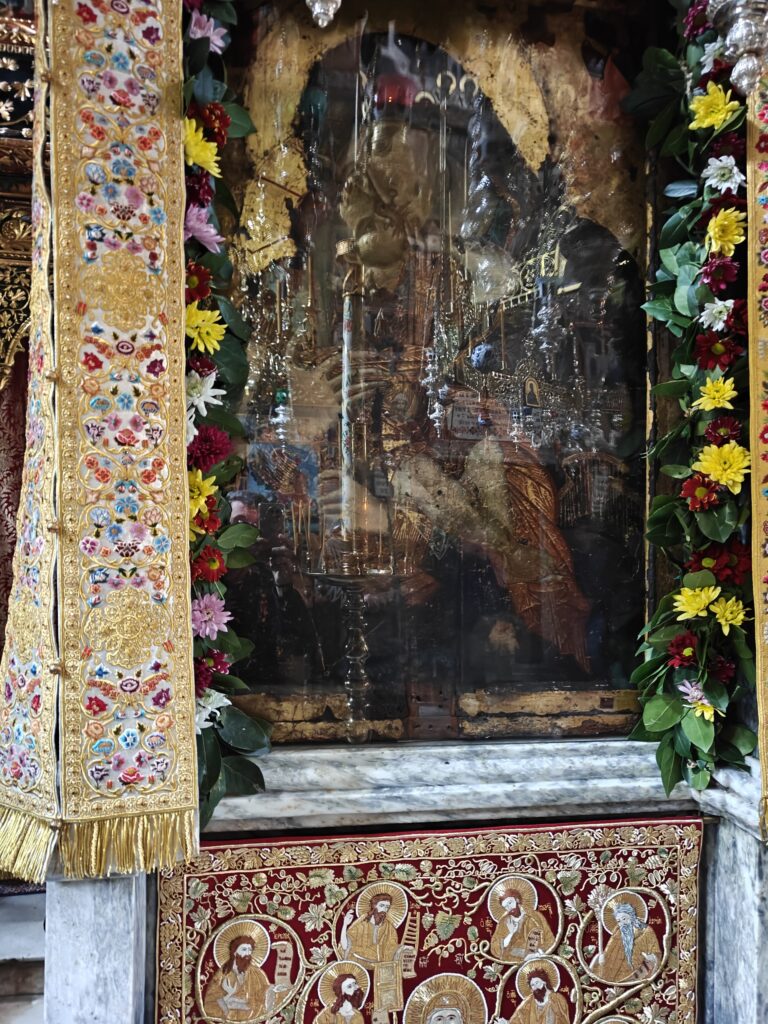
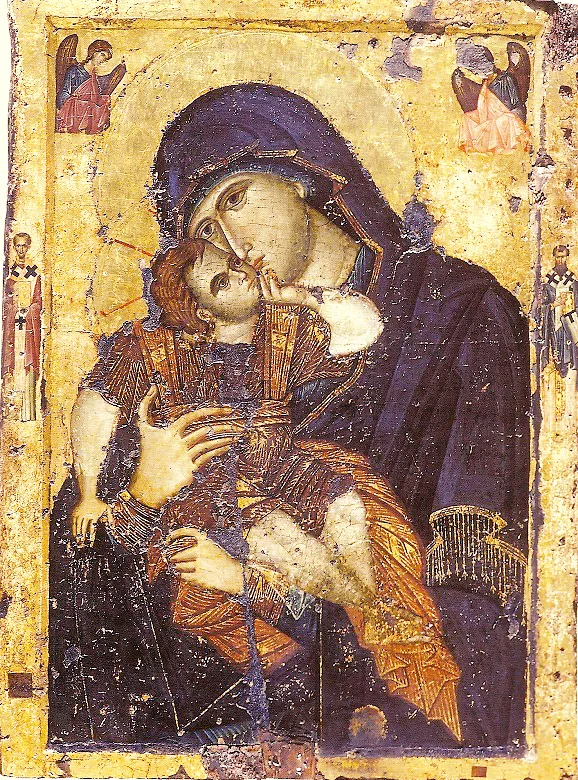
Cheek to cheek
The type of the Glykophilousa is distinguished by the cheek of the Theotokos resting upon the cheek of the Child — an expression of tenderness and of the mystical foreknowledge of the Passion.
The three stars
Upon the maphorion, one star on the forehead and one on each shoulder — a sign of ever-virginity before, during, and after the birth-giving.
The Child’s tunic
Woven with gold, a symbol of the divine glory. The young Christ holds a scroll — the word of life He will proclaim.
The golden ground
The golden ground is not decoration — it is the uncreated light, the place where time meets eternity.