Holy Monastery of Philotheou
Twelfth in rank among the twenty ruling monasteries of Mount Athos. It was founded around the year 990 A.D. by Saint Philotheos and his brothers Dionysios and Arsenios, dedicated to the Annunciation of the Theotokos.
Ten centuries
of unceasing prayer
The Monastery was raised upon the ruins of an older hermitage of Saint Peter the Athonite. For ten centuries, life within its walls has unfolded by the Byzantine clock and typikon, with all-night services and meals kept in silence.
« This place was overshadowed by the Panagia — and since then has never ceased. »
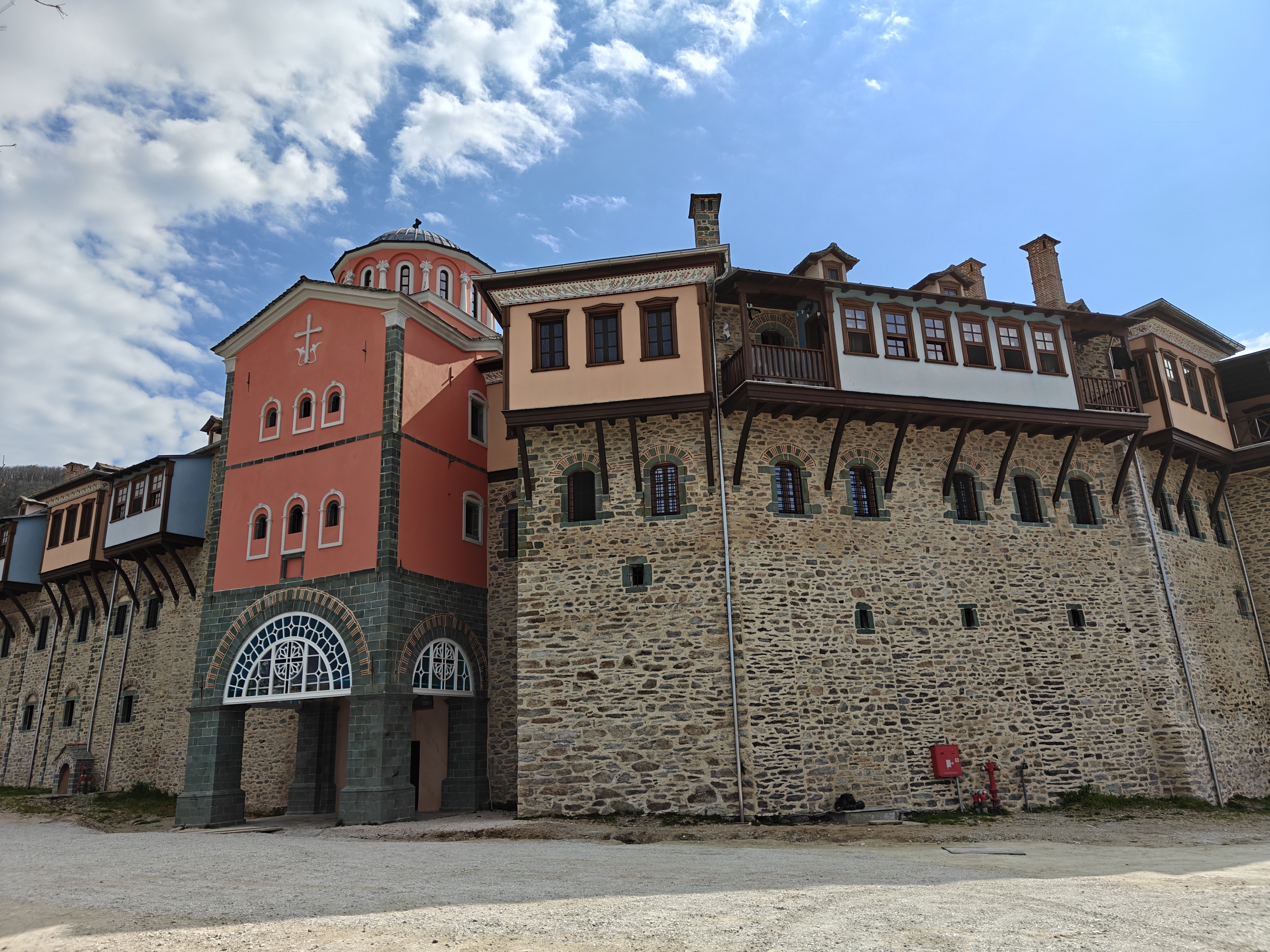
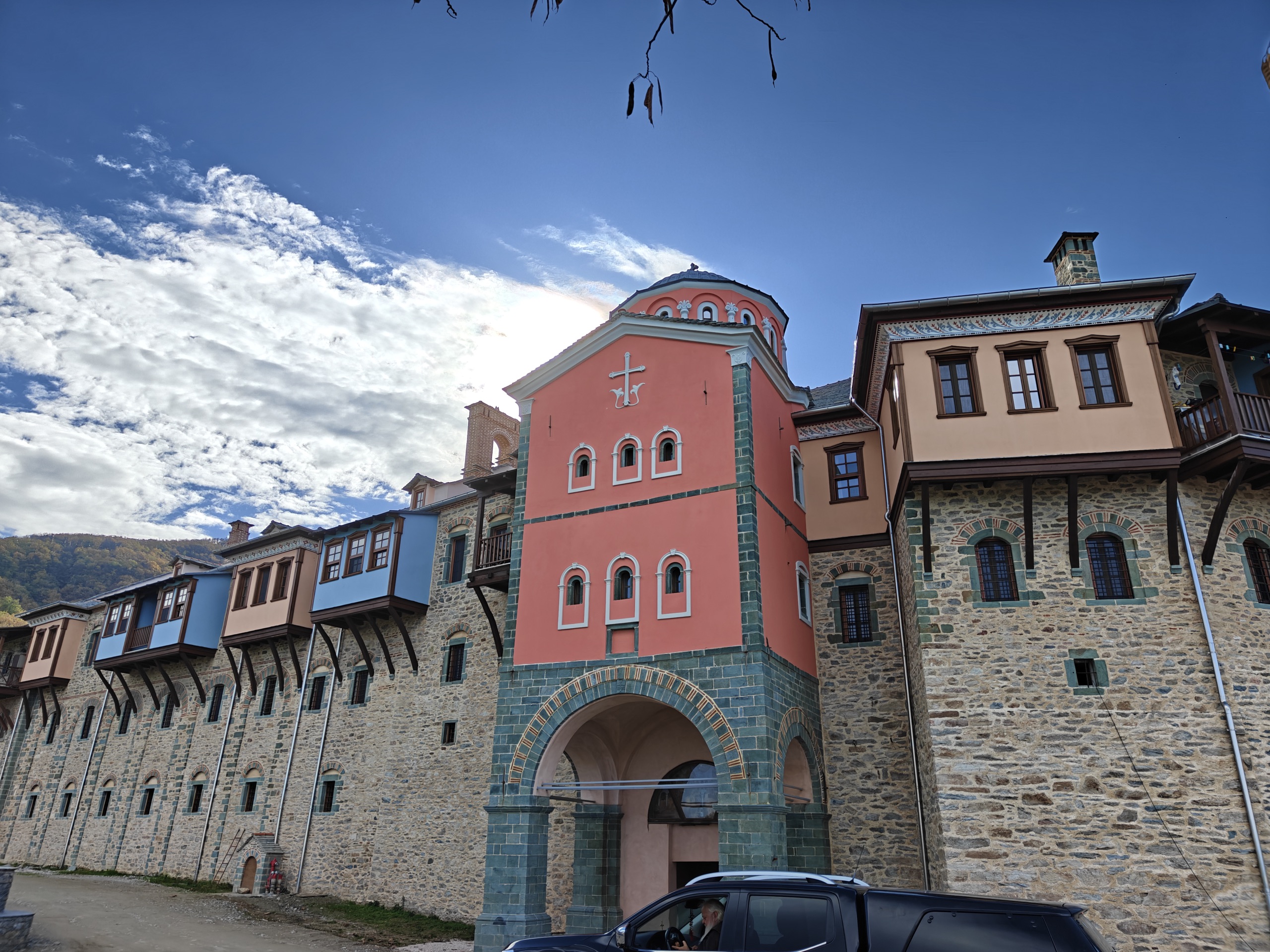
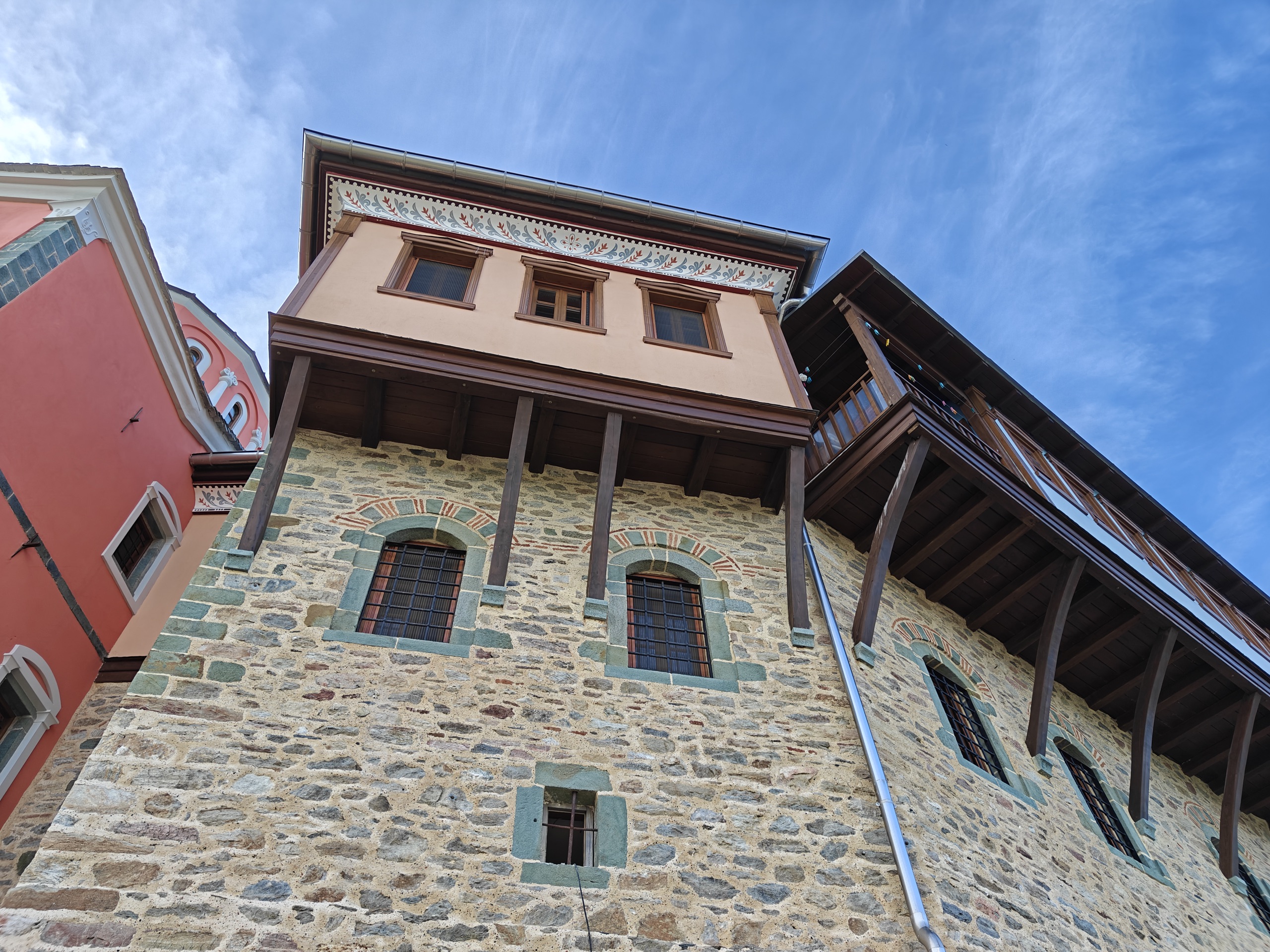
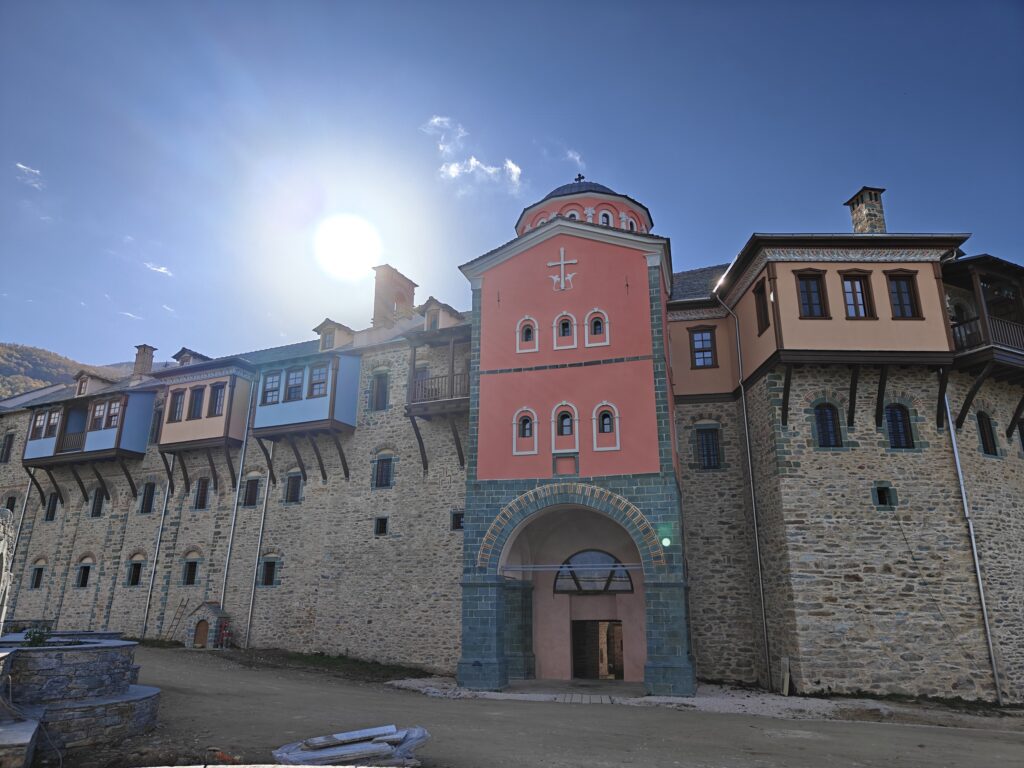
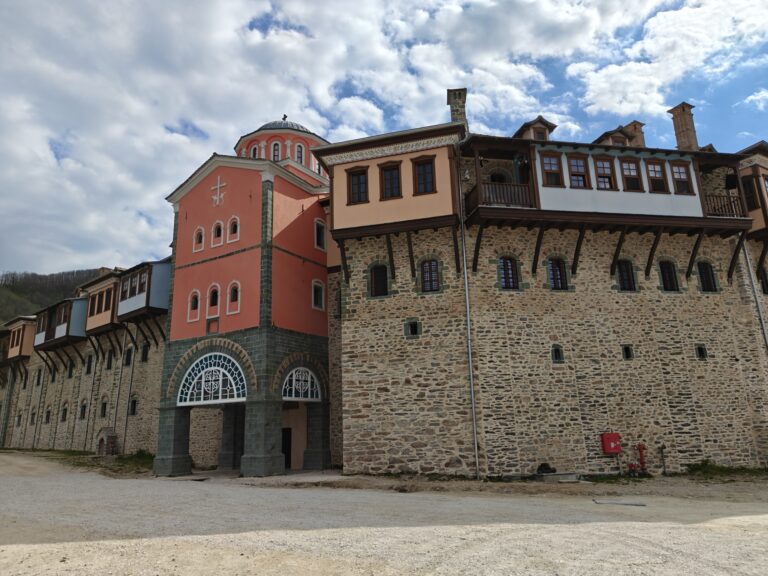
Fires during the 17th and 19th centuries destroyed a great part of the old complex. The present complex is the result of successive renovations — the last completed in 2010, which restored the distinctive colours of the Athonite tradition: a coral-hued tower, blue-green plinths, and wooden bay windows.
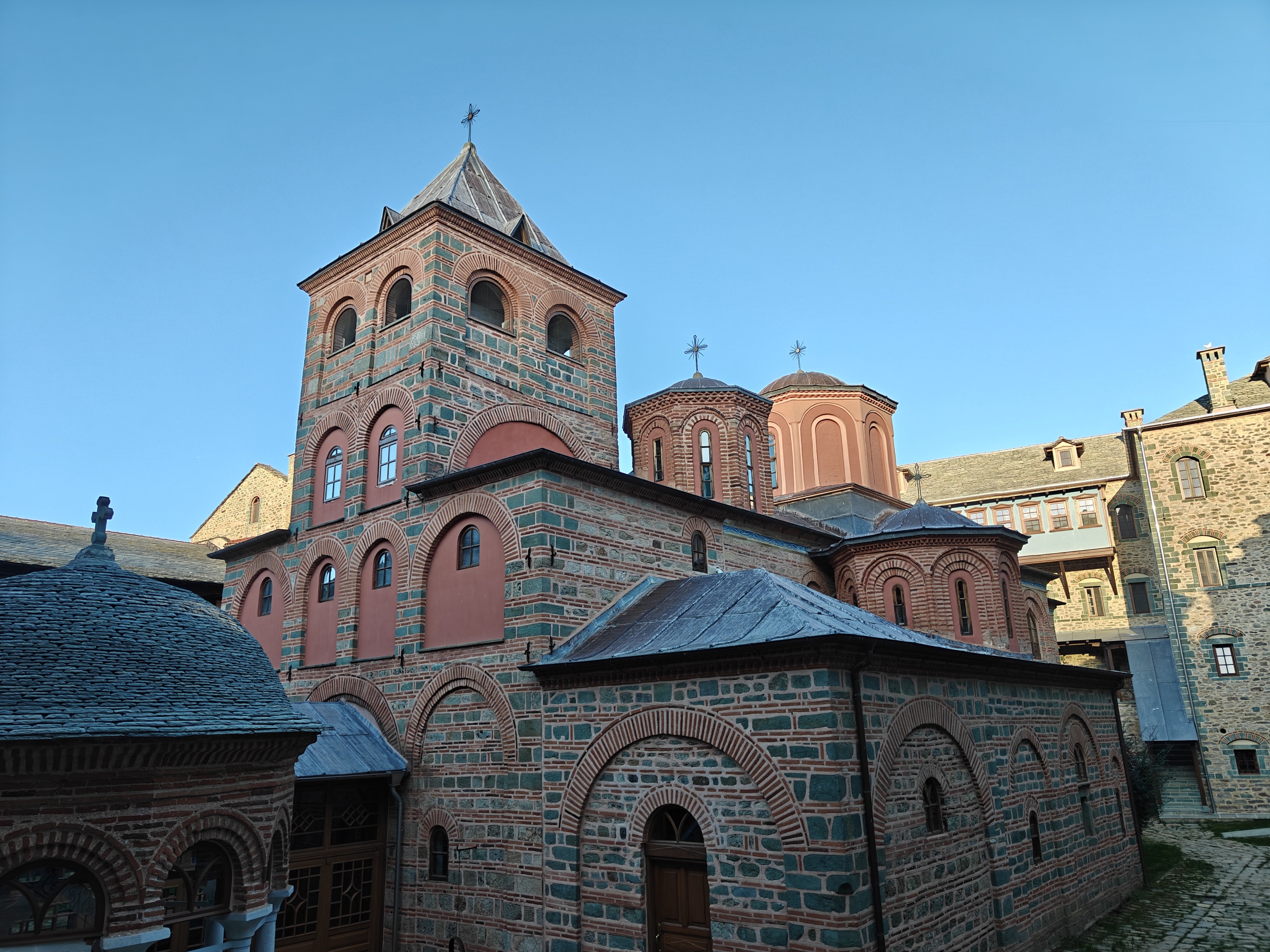
Church of the Annunciation
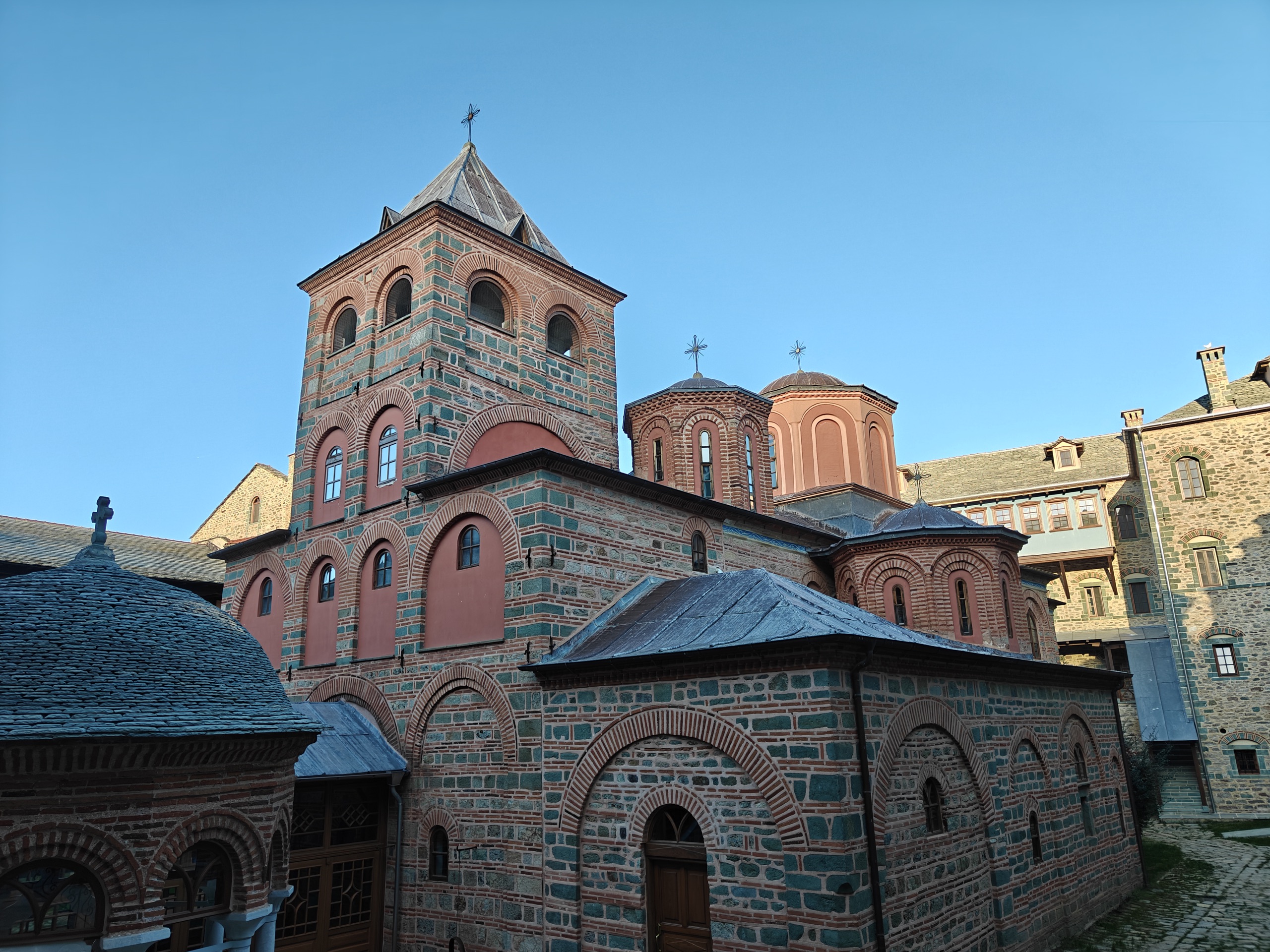
Triconch Athonite type with a dome.
The Annunciation — the heart of the Monastery
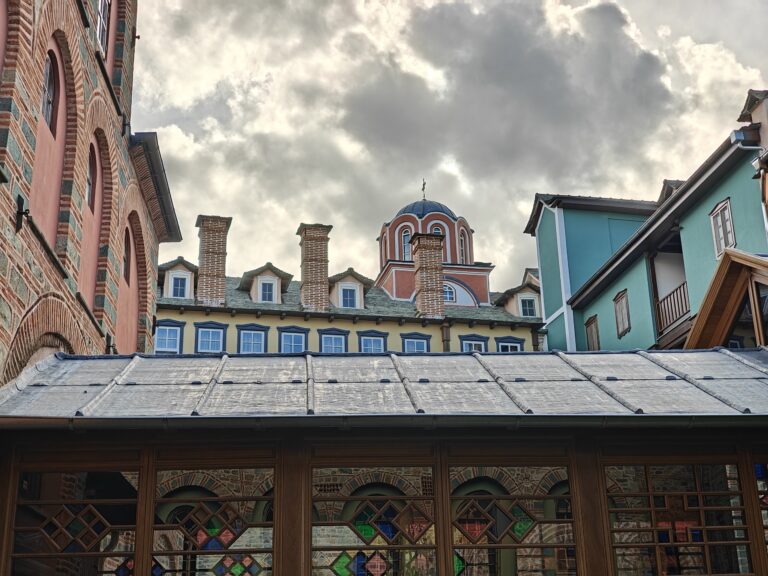
The catholicon follows the composite Athonite type of a triconch church with a dome. Within, the gilded iconostasis, the silver lamps and the 16th-century wall-paintings converge upon the proskynetarion of the Glykophilousa — there where the Paraklesis is celebrated daily.
Ten centuries of presence
The Holy Monastery of Philotheou, one of the twenty holy Monasteries of Mount Athos, is built at an altitude of 316 metres, on the north-eastern side of Athos, upon a most verdant plateau amid green fields, with an exceptional view toward Pangaion, Kavala, Thasos and Samothrace; together with the neighbouring Monastery of Karakallou and the Great Lavra it forms the triad of Athonite Monasteries planted, perhaps, upon the most beautiful part of the Holy Peninsula. It lies 2.5 hours’ walk from Karyes, 1.5 hours from Iviron, and about 30 to 40 minutes from Karakallou and the sea.
It owes its name to the hesychast Saint Philotheos, by tradition a disciple of Saint Athanasios the Athonite, in whose days there seems to have existed, before 992, a small monastery at first called ‘of the Fern’, from the plant of that name abounding in the region of Kravvatos, where, as a remnant of an ancient settlement, a chapel of the Prophet Elijah survives to this day.
Historically it appears to predate 1015, the year in which, in a document of the Protos of the Mountain Nikephoros, among other superiors, there also signs ‘George, monk and abbot of Philotheou’. And in another, of 1016, there signs ‘George, monk and abbot of the Monastery of the lord Philotheos’.
Evidently the presence of Saint Philotheos in the region where the Monastery now stands, together with his virtue and renown as a disciple of Saint Athanasios, absorbed the surrounding small hermitages of that archaic Athonite monasticism, and thereafter it prevailed, named after its Founder the Monastery of Philotheou.
In the typikon of the Emperor Constantine Monomachos (1045) the monk Loukas signs twelfth as abbot of the Monastery of the Theotokos, or of Philotheou, of the Evangelistria. In 1394 it holds the thirteenth place, while in 1574 it returns and remains thereafter twelfth.
It took the complete form of an Athonite four-sided enclosure in the course of the 11th century, with the donations of the Emperor Nikephoros Botaneiates (1078–1081).
Under the Palaiologoi — Andronikos II, Andronikos III, and John V — it was richly benefacted on account of the virtue of its abbot Makarios, whom the Emperor Andronikos, by a chrysobull of 1284, appointed spiritual father of the Palace. Grateful for the spiritual benefit, Andronikos ordained for the Monastery an annual grant of ‘ten great talents’; and, responding to a noble request of the spiritual father, he offered to the Monastery a most precious gift — the incorrupt right hand of Saint John Chrysostom.
The buildings of the Palaiologoi were confirmed by chrysobull by the Serbian Emperor Stefan Dušan (1346), gracefully advancing his wish to see the Slavic element spread in the future upon Mount Athos. His own dedication to the Monastery is the sizeable portion of the Precious Wood of the Life-giving Cross of the Lord.
In the 16th century Athos, beset with troubles, received many from all quarters. After the Fall of Constantinople, among the Monasteries that knew a temporary depopulation was Philotheou, which around 1480 passed through a period of desolation. Then a group of Slavic-speaking monks entered, who brought into the Monastery their idiorrhythmic manner of life. The result of the long friction was that Saints Dionysios of Olympos and Symeon the Barefoot were removed from the abbacy — yet by their sacrifice they brought matters back again to their right, traditional cenobitic course.
The Iberian rulers Leo and Alexander (1492) benefacted the Monastery generally, also enlarging the refectory to its present dimensions.
In June 1533 the Monastery, being in poverty, sold to Gregory Giromerites the Monastery of Stavronikita — until then under its jurisdiction at the rank of a cell — reconstituted thereafter as a Monastery and taking the 15th place among the twenty Holy Monasteries of Mount Athos.
In 1641 the Tsar Michael Theodorovich granted the Philotheites leave to travel to Russia every seventh or eighth year to gather alms, or ‘zeteia’ in the language of the time.
In 1734 the ruler of Wallachia John Gregory Ghika ordained by chrysobull, in favour of the Monastery, 6,600 coins annually, on condition that the right hand of Saint John Chrysostom be sent to the principality for the sanctification of the faithful. The voivode Constantine Mavrokordatos showed the same generosity. The Monastery was again renovated and the present Catholicon was raised (1746).
On 26 September 1871 a great fire reduced to ashes the four-sided enclosure of the Monastery, the Catholicon being endangered and the manuscripts saved. It was rebuilt over more than twenty years, but felt itself so financially exhausted that in 1899 it had recourse to the Holy Community, which sympathetically aided it by a decision of 3 March 1900.
At that time the Holy Monastery had not a few scattered dependencies: in Thasos, Lemnos, Kalamaria, Kassandra, Ormylia, Nigrita, Adrianople, and a whole village in Tiflis of Georgia, called Zem Khotasen (‘upper village’), with a chapel of the Annunciation, with mills, vineyards and various estates — a remnant of the donation of the devout kings of Iberia of the 16th century.
The central Church of the Monastery, the ‘Catholicon’, is honoured from the beginning in the name of the Annunciation of the ever-virgin Mother of God. Over the lintel of the exit from the main Church to the Lite was set the inscription: ‘This divine and all-venerable Church was raised from its foundations… in the year of Christ 1746; it was painted in the year 1752 by the hand of Constantine and his brother Athanasios from Korytsa.’
The wall-painting of the Lite and the outer narthex was done in 1765. The marble paving in 1848, by Kaisarios from Argos. The bell-tower and the lead roofing were completed in March 1765. The wooden iconostasis is from the previous church, which the Russian traveller Vasily Barsky drew in 1744.
The glory of the Monastery is the icon of the Panagia Glykophilousa, of wondrous art and expression, set upon the left column of the Catholicon; full of grace, vividness and majesty, wondrously saved from the iconoclasm and come to the Monastery by sea. Wondrously also there came to the Monastery, from the dependency of Nigrita, the Palaiologan-art icon of the Panagia of Mercy (Eleousa), called ‘the Gerontissa’.
The Holy Monastery has nine chapels — six within and three without. In addition, one of the Prophet Elijah at the place Kravvatos, one at the Arsanas of Saint Lazarus, and the one at the Representation house in Karyes in the name of the Holy Hieromartyr and Equal-to-the-Apostles Cosmas of Aetolia.
The Refectory stands incorporated into the first floor of the West wing, opposite the entrance of the Catholicon — adorned with wall-paintings of unusual size and dynamic expression, of Cretan style. It bears an inscription: ‘In the year 1540 it was renovated… by the most pious Leo, King of Kakheti of Iberia, and his son Alexander.’
The library contains about 390 manuscripts. Of these, the oldest is the thirty-six-leaf remnant of a parchment Evangelistary of the 8th century in majuscule script. There also survive two scrolls of the 14th century, containing the Divine Liturgy of Basil the Great. The Monastery has very few older printed books, owing to the fire of 1871.
At the Arsanas of the Monastery by the sea is the Holy Spring of the Glykophilousa. It wells up perpetually there where the icon of the Panagia stood when it came forth from the waters. The holy water neither diminishes nor changes its temperature, winter or summer.
On 1 October 1973, by decision of the Holy Community and by Sigillion of the Ecumenical Patriarch Demetrios I, it was changed from idiorrhythmic to cenobitic, with a then thirty-member Brotherhood, under the abbot Elder Archimandrite Ephraim, a spiritual offspring of the renowned holy Elder Joseph the Hesychast, the Cave-dweller.
From the trunk of the Brotherhood there sprang offshoot branches, transplanted within Mount Athos and beyond. In 1979 came the manning of the Holy Monastery of Konstamonitou, in 1980 of Xeropotamou, in 1981 of Karakallou. The same movement, a decade later, reached also the New World, America and Canada — under the spiritual oversight of the former-abbot Ephraim, spiritual Father of the whole expanding Brotherhood.
Identity of the Monastery
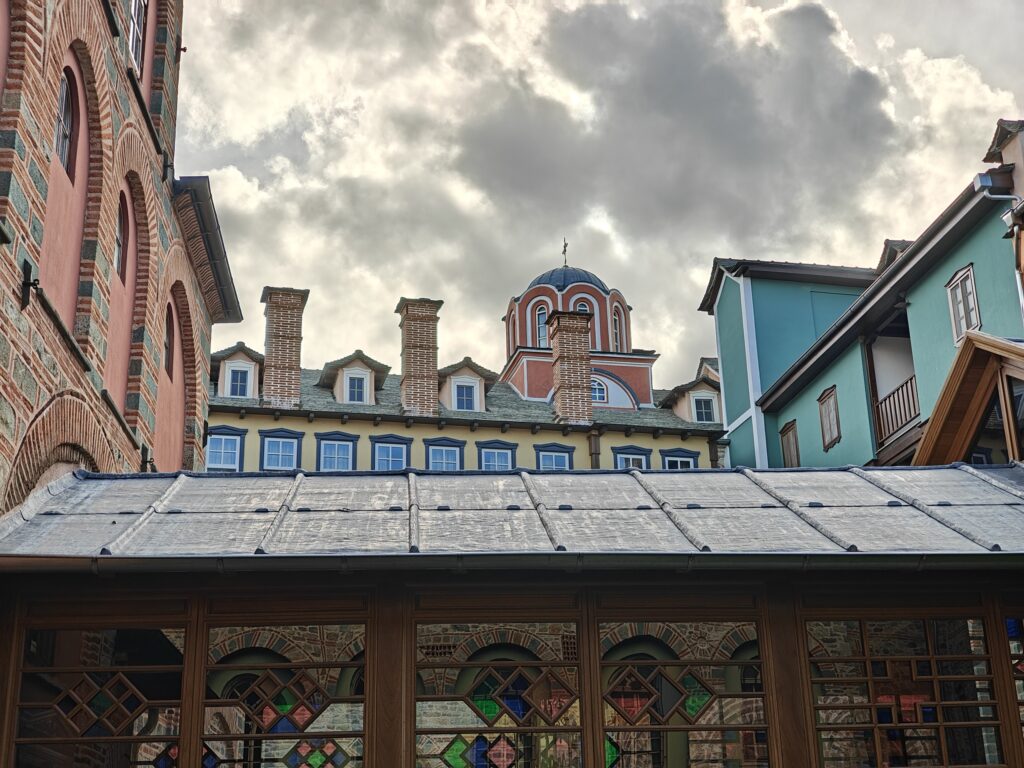
Stone, wood, gold